Game Databases
Every game engine answers the same question: how do you store and query game state? The answer looks a lot like database design.
ECS is a Database
Entity Component System is a database architecture. Entities are row IDs. Components are columns. Systems are queries.
Flecs makes this explicit. An entity with Position and Velocity is a row in a table with those columns. Query for all (Position, Velocity) entities and you’re doing a SELECT. Add a component? ALTER TABLE. Remove an entity? DELETE.
Traditional databases store data row-by-row:
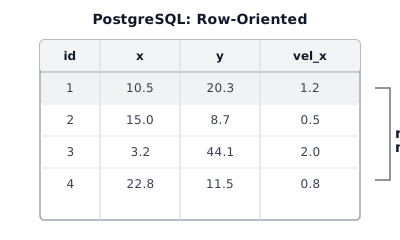
The archetype model in Flecs and Bevy uses columnar storage instead. Entities with the same component set live contiguously in memory:
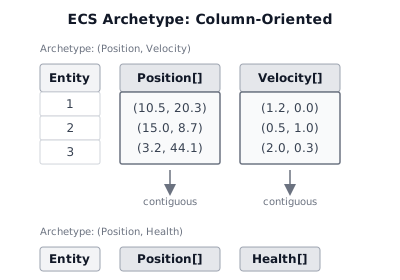
Cache-friendly iteration. Vectorizable operations. The same insight that made columnar databases fast for analytics.
The Consistency Problem
Databases solved consistency decades ago. ACID transactions. Isolation levels. Serializable execution.
Games want parallelism—physics, AI, and networking running concurrently. But concurrent writes to shared state means races, locks, or something cleverer.
Most ECS frameworks punt on this. Bevy schedules systems to avoid conflicts: two systems touching the same component run sequentially. Flecs uses staging—writes buffer, apply later.
Deferred Writes
I’m building a parallel Minecraft engine. The ECS defers all .set() calls until tick end. Every system sees a consistent snapshot. No locks. Full parallelism.
The cost? Systems decide on stale data.
Lost updates. Two systems read Health = 100. One queues -10, one queues -20. Last write wins:
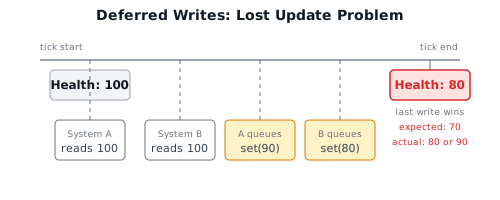
You get 90 or 80, not 70. Damage, velocity impulses, resource counts—anything accumulative breaks.
Read-after-write. System A writes Position. System B reads it later in the same tick. B sees the old value. For Minecraft: place a redstone torch, neighboring dust should react this tick. Lighting should cascade immediately.
Spawn-then-configure. Spawn an entity, immediately configure it. If spawn is deferred, what handle do you have? Pending-entity abstractions ripple into relationships and hierarchies.
Transactions. Pick up item: check inventory, add item, remove from world. If deferred, other systems see inconsistent state. Or two systems race and double-pick-up.
Escape Hatches
Real engines don’t go pure-deferred:
- Sync points: Flush command buffers mid-tick at explicit barriers
- Immediate writes: Component values write immediately; structural changes defer
- Double-buffering: Read current, write next, swap at tick boundary
- Dependency declarations: Tell scheduler what needs to see what
CRDTs: A Different Tradeoff
What if writes composed instead of overwrote? Operation-based CRDTs: Sub(10) and Sub(20) compose to Sub(30) regardless of order:
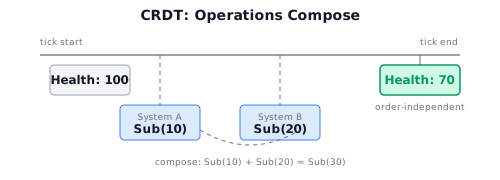
No lost updates. But new problems emerge.
Condition-before-effect. This is the deeper issue:
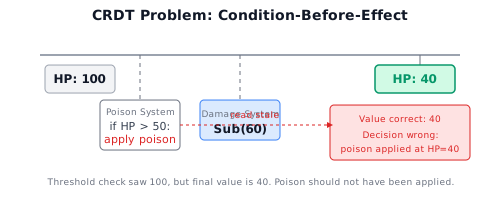
The value converges correctly. The decision was wrong.
Non-commutativity. “Take 50 damage, heal 10% of max” differs from the reverse. Armor with flat reduction before multipliers. CRDTs need commutativity. Redesign mechanics or reintroduce ordering.
Absolute assignments. Clamp health to max. Set health to 50 for a cutscene. These aren’t deltas—they don’t compose with pending ops. Now you’re building LWW-Register + counter hybrids.
The Fundamental Tension
Game state is a database. You want ACID-like consistency. You want parallel execution. You want low latency.
Pick two.
Deferred writes give you parallelism and consistency (within a tick), but decisions lag reality. Immediate writes give you fresh reads, but require coordination. CRDTs give you convergence, but not correct branching.
Every engine makes a different tradeoff. Understanding the tradeoff is the point.